Page 1: THE EIGHT BANNERS
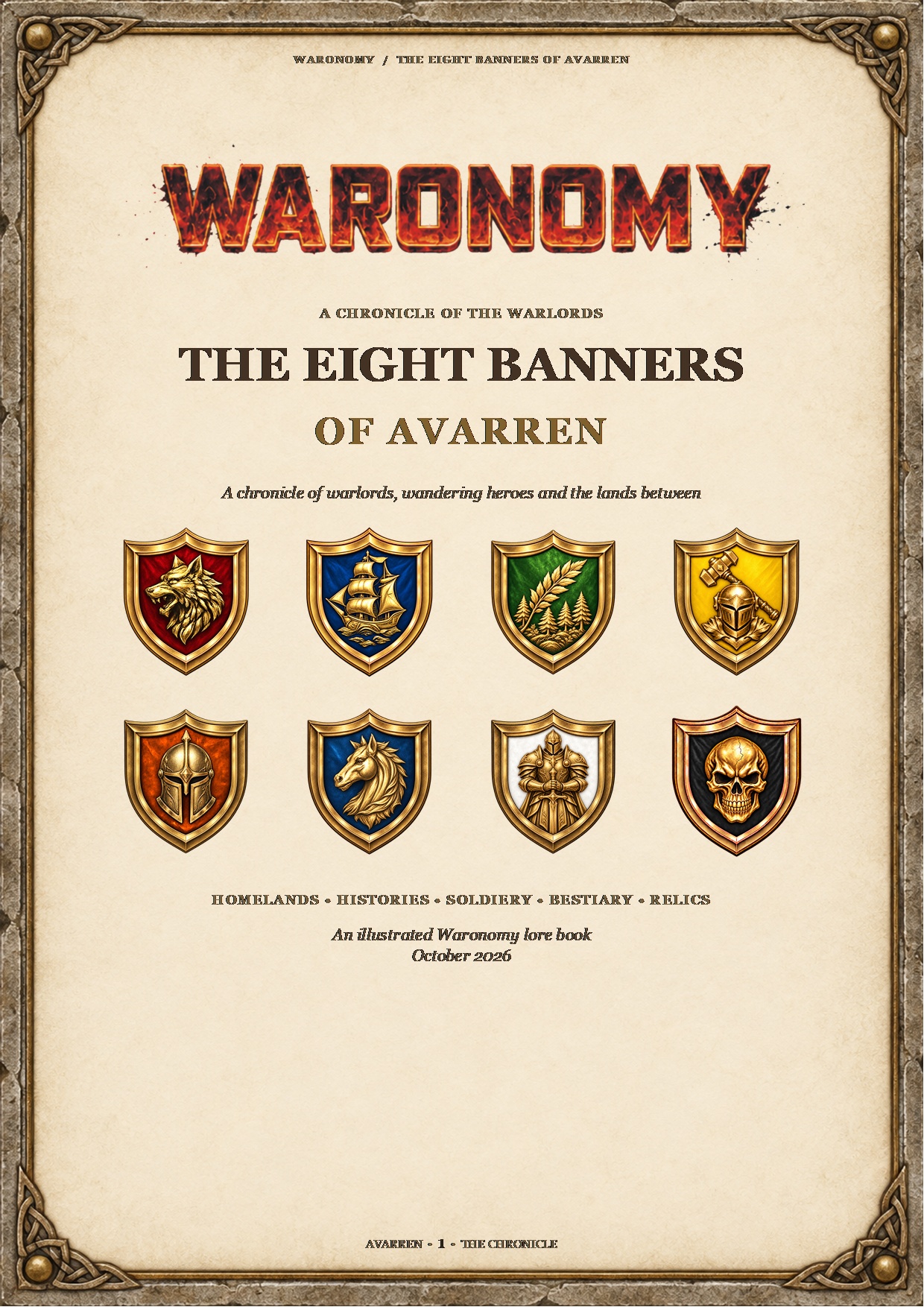
Read page 1 text
THE EIGHT BANNERS
OF AVARREN
An illustrated Waronomy lore book
October 2026
Read the illustrated pages, or open “Read page text” for a larger, selectable text version.
OF AVARREN
An illustrated Waronomy lore book
October 2026
A WORD FROM THE CHRONICLER
Throughout Avarren, eight faction colours are painted above doorways, stitched inside coats and carved into boundary stones.
This book gathers the stories of eight great powers: their homelands, quarrels and the promises that bind them even when their armies meet.
About this book: the eight faction names, 24 unit types, and names and game effects of all 24 artefacts come from Waronomy. Avarren, its map, regional history, characters, customs and legends are new creative material. All eight factions are living powers within this setting. Military traditions describe lore rather than exclusive recruitment rules.
THE KNOWN LANDS
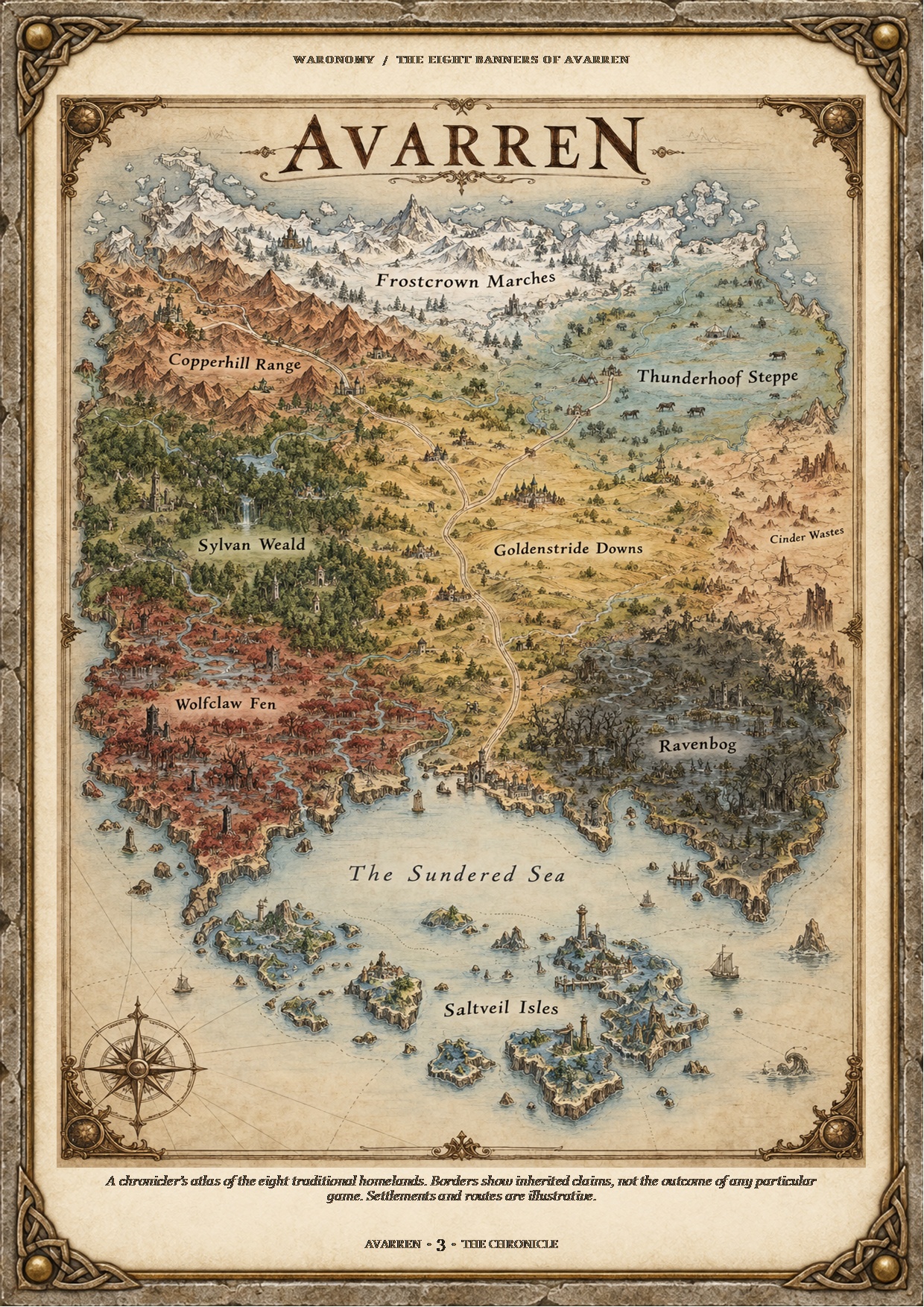
A chronicler’s atlas of the eight traditional homelands. Borders show inherited claims, not the outcome of any particular game. Settlements and routes are illustrative.
ROADS, REGIONS & DISPUTED GROUND
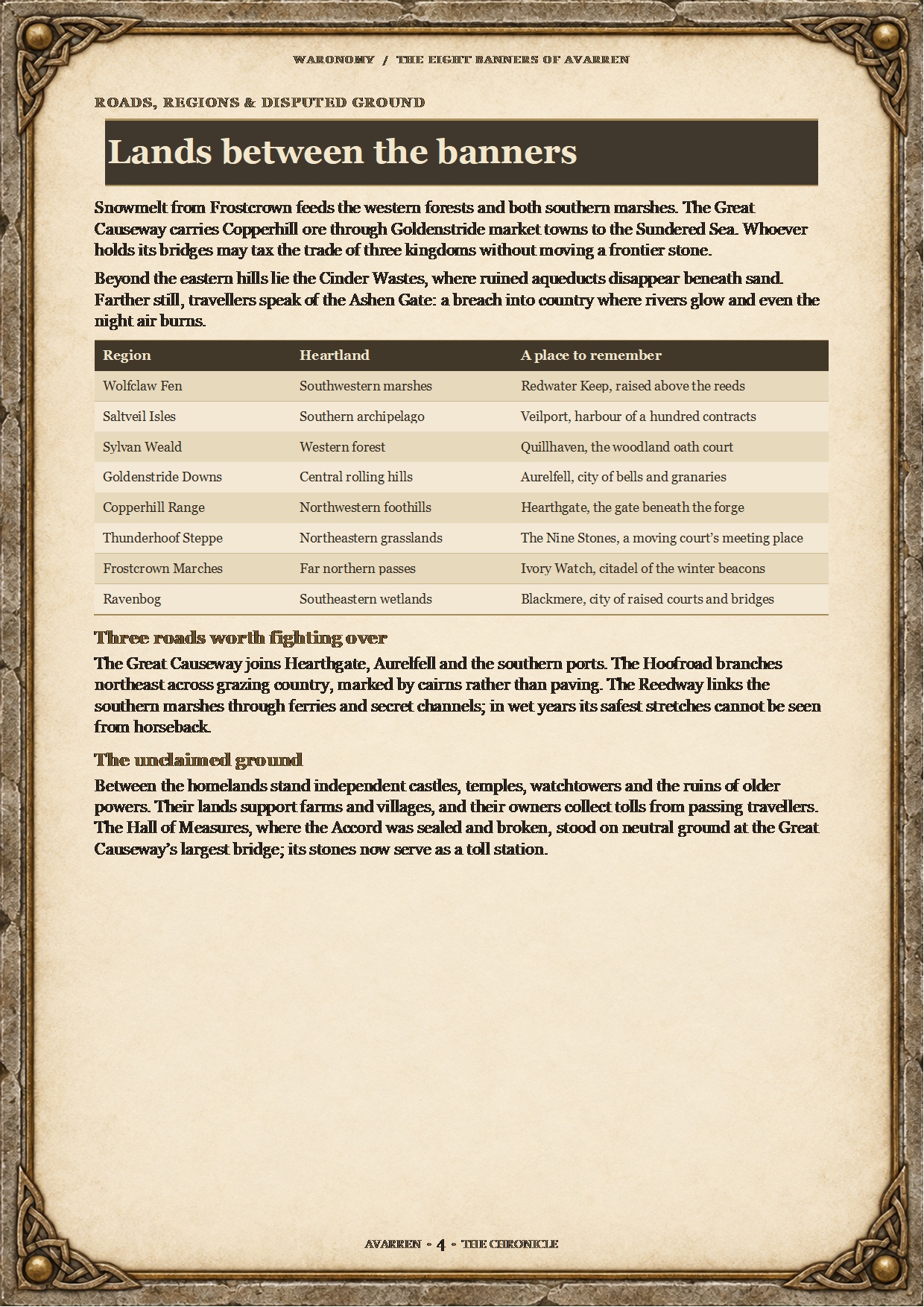
Snowmelt from Frostcrown feeds the western forests and both southern marshes. The Great Causeway carries Copperhill ore through Goldenstride market towns to the Sundered Sea. Whoever holds its bridges may tax the trade of three kingdoms without moving a frontier stone.
Beyond the eastern hills lie the Cinder Wastes, where ruined aqueducts disappear beneath sand. Farther still, travellers speak of the Ashen Gate: a breach into country where rivers glow and even the night air burns.
| Region | Heartland | A place to remember |
|---|---|---|
| Wolfclaw Fen | Southwestern marshes | Redwater Keep, raised above the reeds |
| Saltveil Isles | Southern archipelago | Veilport, harbour of a hundred contracts |
| Sylvan Weald | Western forest | Quillhaven, the woodland oath court |
| Goldenstride Downs | Central rolling hills | Aurelfell, city of bells and granaries |
| Copperhill Range | Northwestern foothills | Hearthgate, the gate beneath the forge |
| Thunderhoof Steppe | Northeastern grasslands | The Nine Stones, a moving court’s meeting place |
| Frostcrown Marches | Far northern passes | Ivory Watch, citadel of the winter beacons |
| Ravenbog | Southeastern wetlands | Blackmere, city of raised courts and bridges |
The Great Causeway joins Hearthgate, Aurelfell and the southern ports. The Hoofroad branches northeast across grazing country, marked by cairns rather than paving. The Reedway links the southern marshes through ferries and secret channels; in wet years its safest stretches cannot be seen from horseback.
Between the homelands stand independent castles, temples, watchtowers and the ruins of older powers. Their lands support farms and villages, and their owners collect tolls from passing travellers. The Hall of Measures, where the Accord was sealed and broken, stood on neutral ground at the Great Causeway’s largest bridge; its stones now serve as a toll station.
THE BREAKING OF THE ACCORD
The Eightfold Accord began as a practical bargain. Copperhill stonecutters laid roads, Saltveil captains kept the southern crossings open, Goldenstride supplied grain, and the forest and marsh peoples guarded the headwaters. Thunderhoof riders carried messages. Skywarden beacon towers watched the northern passes; Ravenbog judges kept the written record of debts. There was no single emperor. Each agreement required all eight seals.
During the Long Rime, three northern harvests failed. Skywarden commanders closed the passes to keep their own people fed. Refugees crowded the low roads; grain barges vanished in the southern wetlands. Forged orders circulated under eight apparently genuine seals, each authorising a different house's claim. Each house believed another had stolen its rights. At the Hall of Measures, the last council broke up before the candles burned down.
The Long Rime tested every house. Skywarden crews kept the northern beacons burning while Thunderhoof riders guided relief caravans through the snow. In Ravenbog, floodwater tore barges from their moorings, but the Dragoons held the embankments and carried the court archive to higher halls. Each warlord emerged certain that their own people had honoured the Accord more faithfully than anyone else.
The eight powers dispute borders, tolls and obligations under the Accord. Border castles have become toll stations, and toll stations have become fortresses. A bridge dispute can summon knights, beasts and a hero whose name the villagers have never heard. Trade in iron, salt and grain continues across disputed borders.
The Eightfold Accord was sealed four generations ago. The Long Rime began a generation ago, and the Accord broke in its third winter. Saltstorm’s war against the Saltveil Isles and the Goldenstride Kingdom ended within living memory.
I • THE RED BANNER
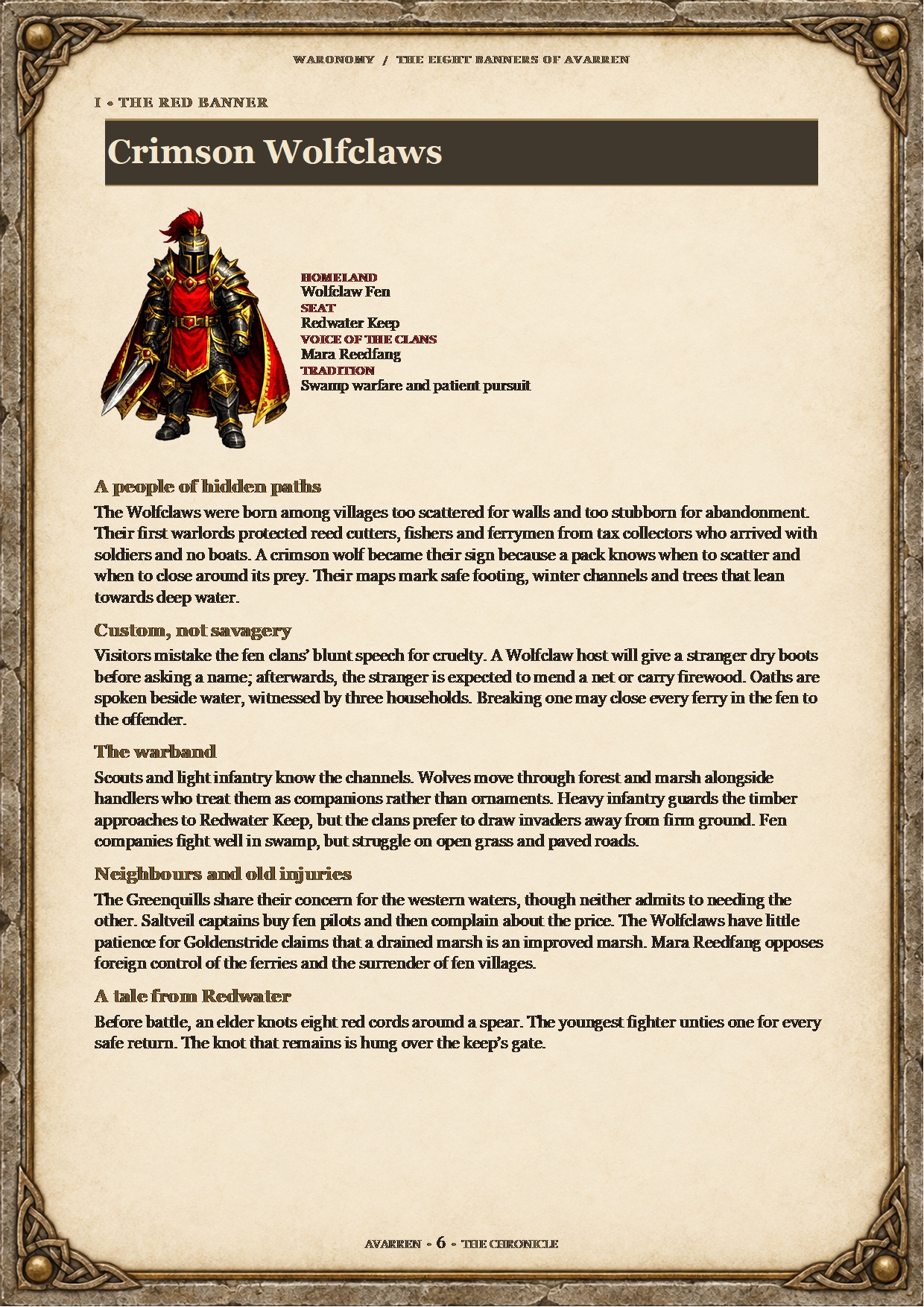
The Wolfclaws were born among villages too scattered for walls and too stubborn for abandonment. Their first warlords protected reed cutters, fishers and ferrymen from tax collectors who arrived with soldiers and no boats. A crimson wolf became their sign because a pack knows when to scatter and when to close around its prey. Their maps mark safe footing, winter channels and trees that lean towards deep water.
Visitors mistake the fen clans’ blunt speech for cruelty. A Wolfclaw host will give a stranger dry boots before asking a name; afterwards, the stranger is expected to mend a net or carry firewood. Oaths are spoken beside water, witnessed by three households. Breaking one may close every ferry in the fen to the offender.
Scouts and light infantry know the channels. Wolves move through forest and marsh alongside handlers who treat them as companions rather than ornaments. Heavy infantry guards the timber approaches to Redwater Keep, but the clans prefer to draw invaders away from firm ground. Fen companies fight well in swamp, but struggle on open grass and paved roads.
The Greenquills share their concern for the western waters, though neither admits to needing the other. Saltveil captains buy fen pilots and then complain about the price. The Wolfclaws have little patience for Goldenstride claims that a drained marsh is an improved marsh. Mara Reedfang opposes foreign control of the ferries and the surrender of fen villages.
Before battle, an elder knots eight red cords around a spear. The youngest fighter unties one for every safe return. The knot that remains is hung over the keep’s gate.
II • THE BLUE BANNER
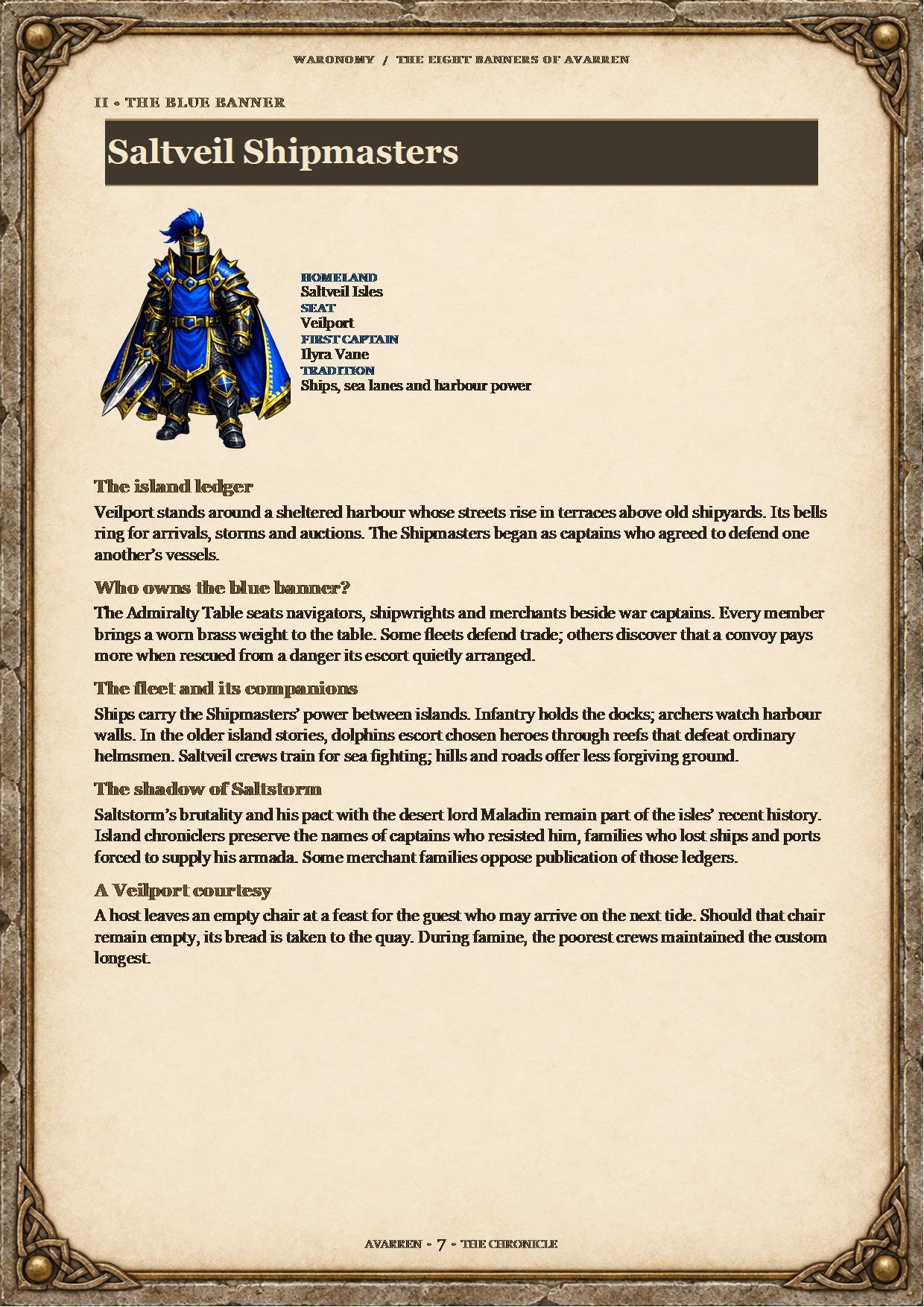
Veilport stands around a sheltered harbour whose streets rise in terraces above old shipyards. Its bells ring for arrivals, storms and auctions. The Shipmasters began as captains who agreed to defend one another’s vessels.
The Admiralty Table seats navigators, shipwrights and merchants beside war captains. Every member brings a worn brass weight to the table. Some fleets defend trade; others discover that a convoy pays more when rescued from a danger its escort quietly arranged.
Ships carry the Shipmasters’ power between islands. Infantry holds the docks; archers watch harbour walls. In the older island stories, dolphins escort chosen heroes through reefs that defeat ordinary helmsmen. Saltveil crews train for sea fighting; hills and roads offer less forgiving ground.
Saltstorm’s brutality and his pact with the desert lord Maladin remain part of the isles’ recent history. Island chroniclers preserve the names of captains who resisted him, families who lost ships and ports forced to supply his armada. Some merchant families oppose publication of those ledgers.
A host leaves an empty chair at a feast for the guest who may arrive on the next tide. Should that chair remain empty, its bread is taken to the quay. During famine, the poorest crews maintained the custom longest.
III • THE GREEN BANNER
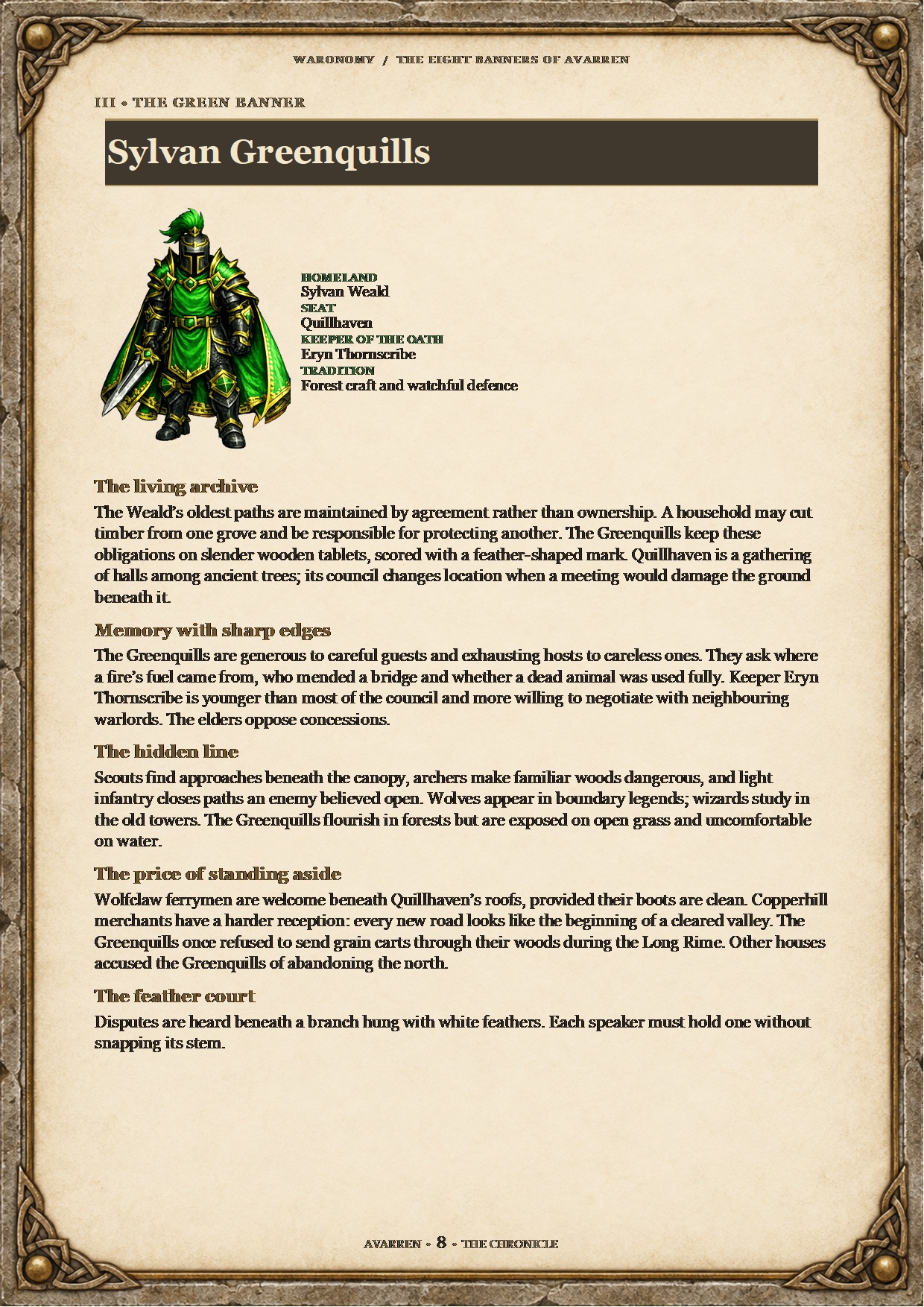
The Weald’s oldest paths are maintained by agreement rather than ownership. A household may cut timber from one grove and be responsible for protecting another. The Greenquills keep these obligations on slender wooden tablets, scored with a feather-shaped mark. Quillhaven is a gathering of halls among ancient trees; its council changes location when a meeting would damage the ground beneath it.
The Greenquills are generous to careful guests and exhausting hosts to careless ones. They ask where a fire’s fuel came from, who mended a bridge and whether a dead animal was used fully. Keeper Eryn Thornscribe is younger than most of the council and more willing to negotiate with neighbouring warlords. The elders oppose concessions.
Scouts find approaches beneath the canopy, archers make familiar woods dangerous, and light infantry closes paths an enemy believed open. Wolves appear in boundary legends; wizards study in the old towers. The Greenquills flourish in forests but are exposed on open grass and uncomfortable on water.
Wolfclaw ferrymen are welcome beneath Quillhaven’s roofs, provided their boots are clean. Copperhill merchants have a harder reception: every new road looks like the beginning of a cleared valley. The Greenquills once refused to send grain carts through their woods during the Long Rime. Other houses accused the Greenquills of abandoning the north.
Disputes are heard beneath a branch hung with white feathers. Each speaker must hold one without snapping its stem.
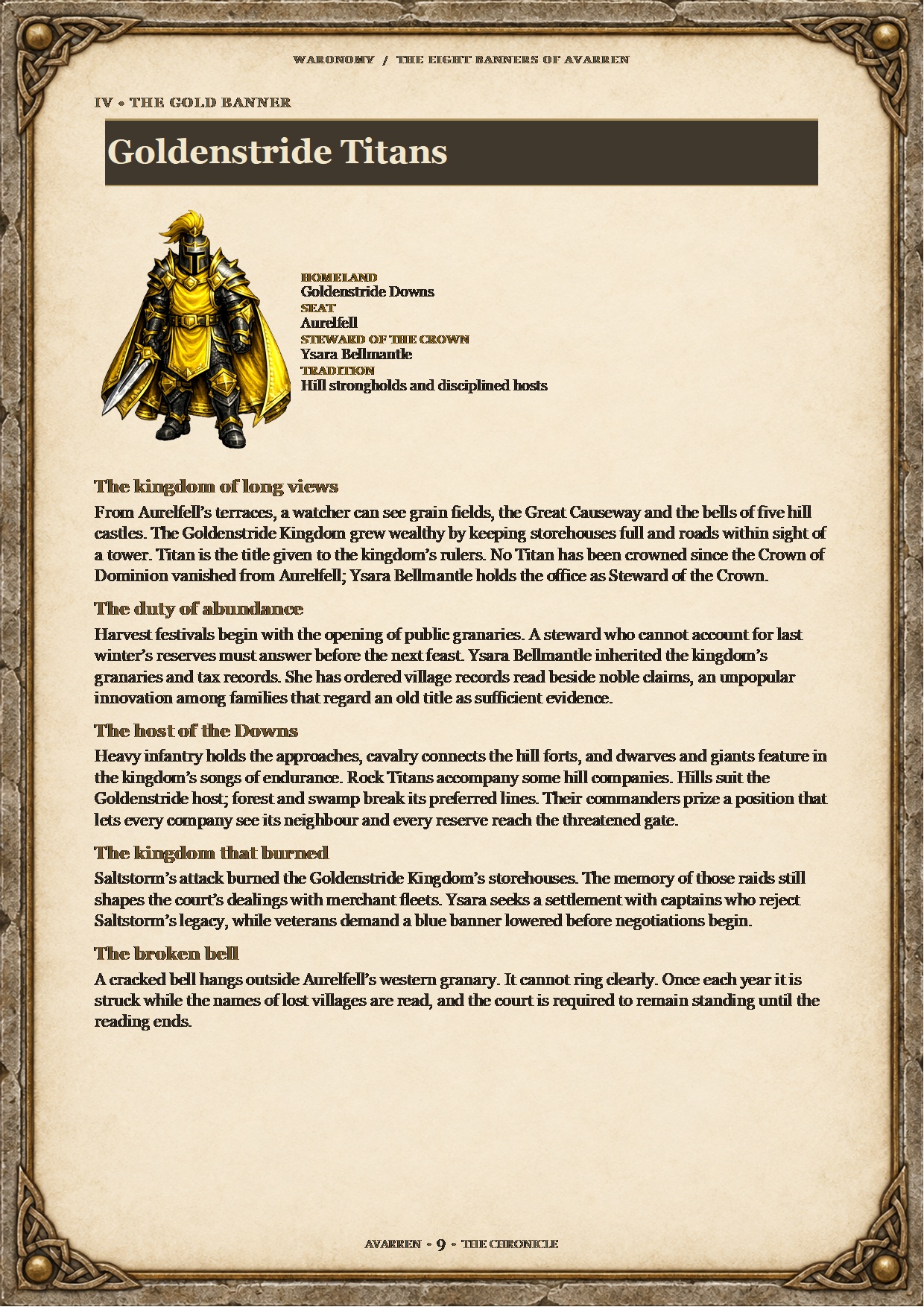
IV • THE GOLD BANNER
From Aurelfell’s terraces, a watcher can see grain fields, the Great Causeway and the bells of five hill castles. The Goldenstride Kingdom grew wealthy by keeping storehouses full and roads within sight of a tower. Titan is the title given to the kingdom’s rulers. No Titan has been crowned since the Crown of Dominion vanished from Aurelfell; Ysara Bellmantle holds the office as Steward of the Crown.
Harvest festivals begin with the opening of public granaries. A steward who cannot account for last winter’s reserves must answer before the next feast. Ysara Bellmantle inherited the kingdom’s granaries and tax records. She has ordered village records read beside noble claims, an unpopular innovation among families that regard an old title as sufficient evidence.
Heavy infantry holds the approaches, cavalry connects the hill forts, and dwarves and giants feature in the kingdom’s songs of endurance. Rock Titans accompany some hill companies. Hills suit the Goldenstride host; forest and swamp break its preferred lines. Their commanders prize a position that lets every company see its neighbour and every reserve reach the threatened gate.
Saltstorm’s attack burned the Goldenstride Kingdom’s storehouses. The memory of those raids still shapes the court’s dealings with merchant fleets. Ysara seeks a settlement with captains who reject Saltstorm’s legacy, while veterans demand a blue banner lowered before negotiations begin.
A cracked bell hangs outside Aurelfell’s western granary. It cannot ring clearly. Once each year it is struck while the names of lost villages are read, and the court is required to remain standing until the reading ends.
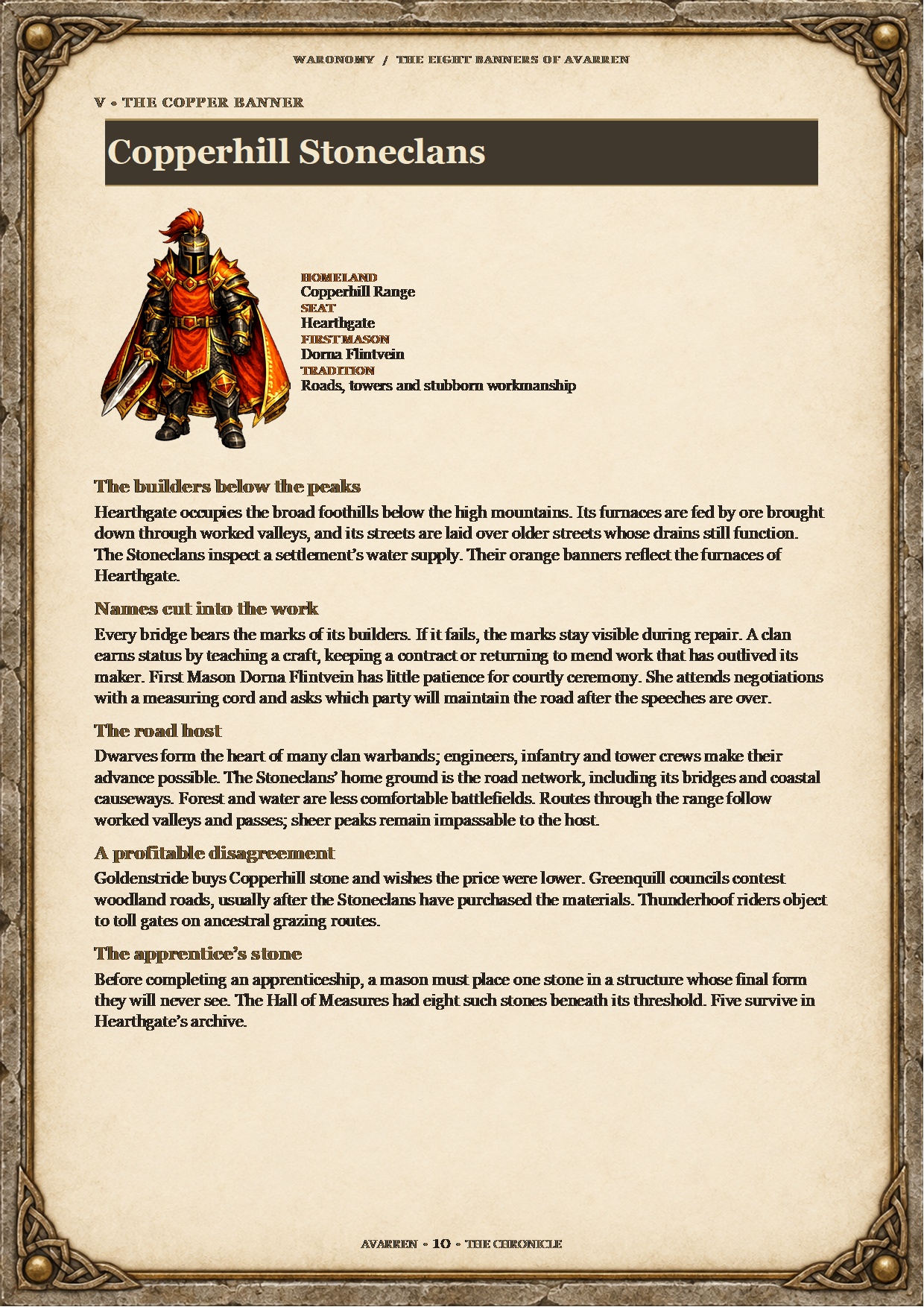
V • THE COPPER BANNER
Hearthgate occupies the broad foothills below the high mountains. Its furnaces are fed by ore brought down through worked valleys, and its streets are laid over older streets whose drains still function. The Stoneclans inspect a settlement’s water supply. Their orange banners reflect the furnaces of Hearthgate.
Every bridge bears the marks of its builders. If it fails, the marks stay visible during repair. A clan earns status by teaching a craft, keeping a contract or returning to mend work that has outlived its maker. First Mason Dorna Flintvein has little patience for courtly ceremony. She attends negotiations with a measuring cord and asks which party will maintain the road after the speeches are over.
Dwarves form the heart of many clan warbands; engineers, infantry and tower crews make their advance possible. The Stoneclans’ home ground is the road network, including its bridges and coastal causeways. Forest and water are less comfortable battlefields. Routes through the range follow worked valleys and passes; sheer peaks remain impassable to the host.
Goldenstride buys Copperhill stone and wishes the price were lower. Greenquill councils contest woodland roads, usually after the Stoneclans have purchased the materials. Thunderhoof riders object to toll gates on ancestral grazing routes.
Before completing an apprenticeship, a mason must place one stone in a structure whose final form they will never see. The Hall of Measures had eight such stones beneath its threshold. Five survive in Hearthgate’s archive.
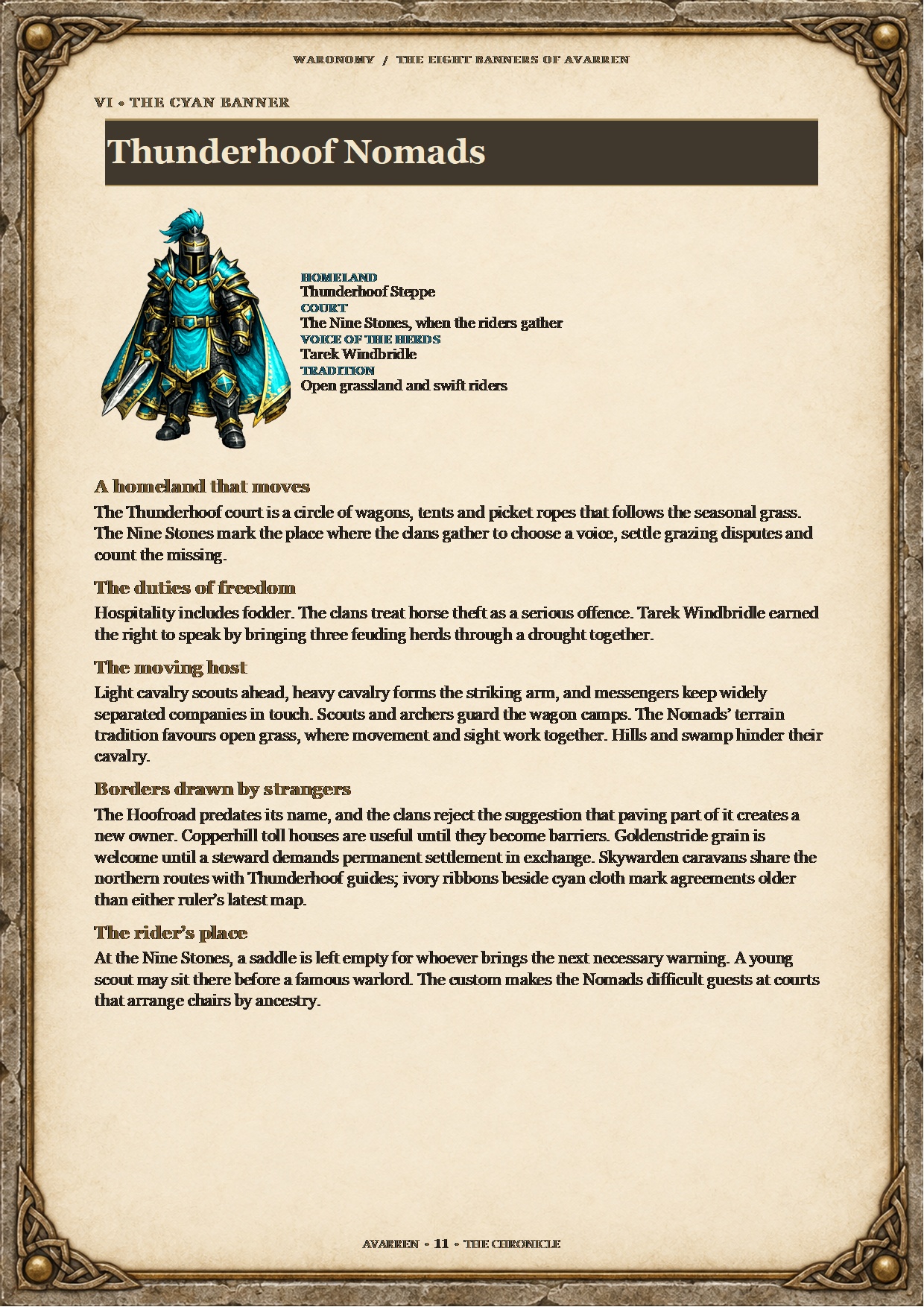
VI • THE CYAN BANNER
The Thunderhoof court is a circle of wagons, tents and picket ropes that follows the seasonal grass. The Nine Stones mark the place where the clans gather to choose a voice, settle grazing disputes and count the missing.
Hospitality includes fodder. The clans treat horse theft as a serious offence. Tarek Windbridle earned the right to speak by bringing three feuding herds through a drought together.
Light cavalry scouts ahead, heavy cavalry forms the striking arm, and messengers keep widely separated companies in touch. Scouts and archers guard the wagon camps. The Nomads’ terrain tradition favours open grass, where movement and sight work together. Hills and swamp hinder their cavalry.
The Hoofroad predates its name, and the clans reject the suggestion that paving part of it creates a new owner. Copperhill toll houses are useful until they become barriers. Goldenstride grain is welcome until a steward demands permanent settlement in exchange. Skywarden caravans share the northern routes with Thunderhoof guides; ivory ribbons beside cyan cloth mark agreements older than either ruler’s latest map.
At the Nine Stones, a saddle is left empty for whoever brings the next necessary warning. A young scout may sit there before a famous warlord. The custom makes the Nomads difficult guests at courts that arrange chairs by ancestry.
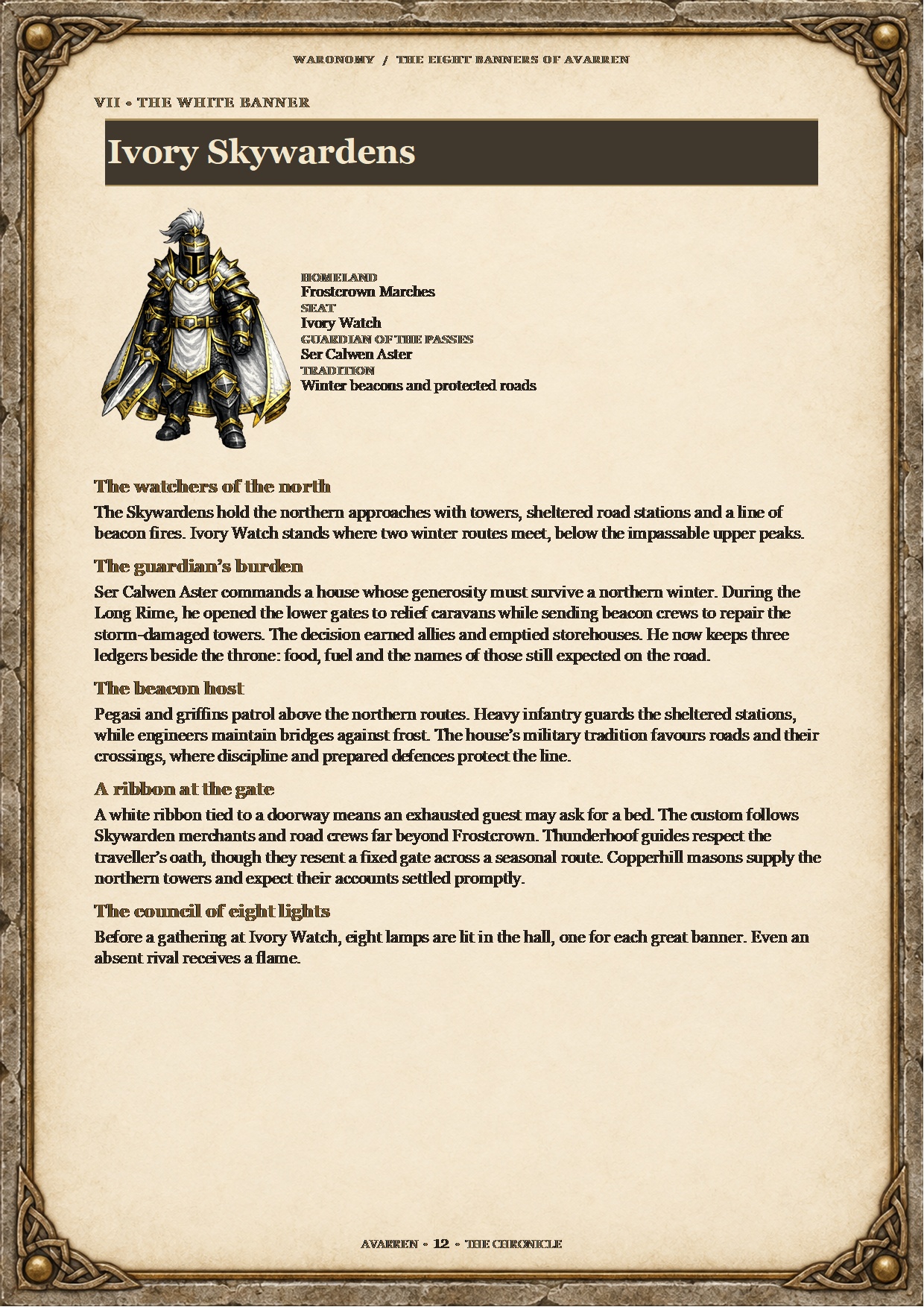
VII • THE WHITE BANNER
The Skywardens hold the northern approaches with towers, sheltered road stations and a line of beacon fires. Ivory Watch stands where two winter routes meet, below the impassable upper peaks.
Ser Calwen Aster commands a house whose generosity must survive a northern winter. During the Long Rime, he opened the lower gates to relief caravans while sending beacon crews to repair the storm-damaged towers. The decision earned allies and emptied storehouses. He now keeps three ledgers beside the throne: food, fuel and the names of those still expected on the road.
Pegasi and griffins patrol above the northern routes. Heavy infantry guards the sheltered stations, while engineers maintain bridges against frost. The house’s military tradition favours roads and their crossings, where discipline and prepared defences protect the line.
A white ribbon tied to a doorway means an exhausted guest may ask for a bed. The custom follows Skywarden merchants and road crews far beyond Frostcrown. Thunderhoof guides respect the traveller’s oath, though they resent a fixed gate across a seasonal route. Copperhill masons supply the northern towers and expect their accounts settled promptly.
Before a gathering at Ivory Watch, eight lamps are lit in the hall, one for each great banner. Even an absent rival receives a flame.
VIII • THE BLACK BANNER
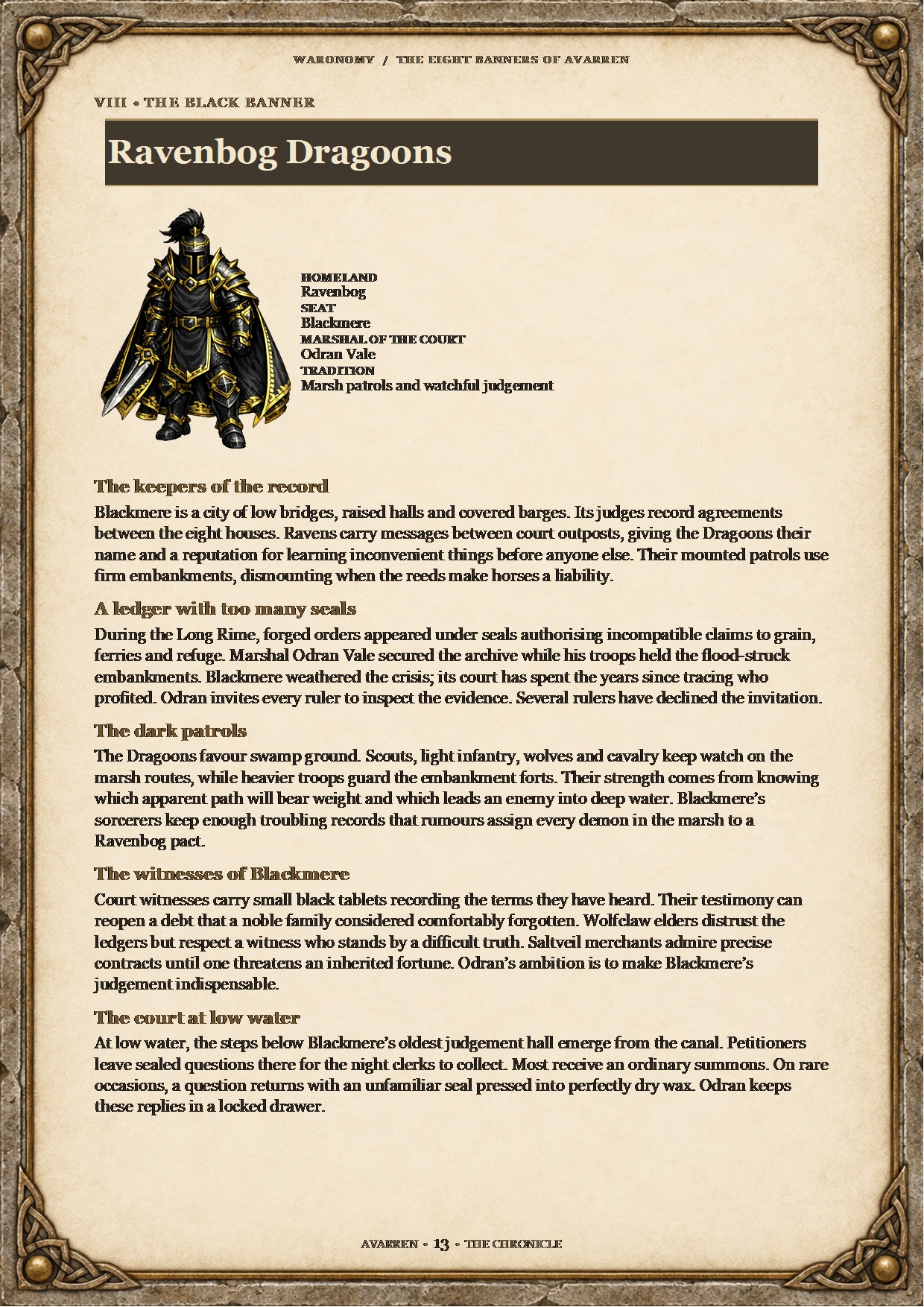
Blackmere is a city of low bridges, raised halls and covered barges. Its judges record agreements between the eight houses. Ravens carry messages between court outposts, giving the Dragoons their name and a reputation for learning inconvenient things before anyone else. Their mounted patrols use firm embankments, dismounting when the reeds make horses a liability.
During the Long Rime, forged orders appeared under seals authorising incompatible claims to grain, ferries and refuge. Marshal Odran Vale secured the archive while his troops held the flood-struck embankments. Blackmere weathered the crisis; its court has spent the years since tracing who profited. Odran invites every ruler to inspect the evidence. Several rulers have declined the invitation.
The Dragoons favour swamp ground. Scouts, light infantry, wolves and cavalry keep watch on the marsh routes, while heavier troops guard the embankment forts. Their strength comes from knowing which apparent path will bear weight and which leads an enemy into deep water. Blackmere’s sorcerers keep enough troubling records that rumours assign every demon in the marsh to a Ravenbog pact.
Court witnesses carry small black tablets recording the terms they have heard. Their testimony can reopen a debt that a noble family considered comfortably forgotten. Wolfclaw elders distrust the ledgers but respect a witness who stands by a difficult truth. Saltveil merchants admire precise contracts until one threatens an inherited fortune. Odran’s ambition is to make Blackmere’s judgement indispensable.
At low water, the steps below Blackmere’s oldest judgement hall emerge from the canal. Petitioners leave sealed questions there for the night clerks to collect. Most receive an ordinary summons. On rare occasions, a question returns with an unfamiliar seal pressed into perfectly dry wax. Odran keeps these replies in a locked drawer.
SOLDIERY I • THE COMMON HOST
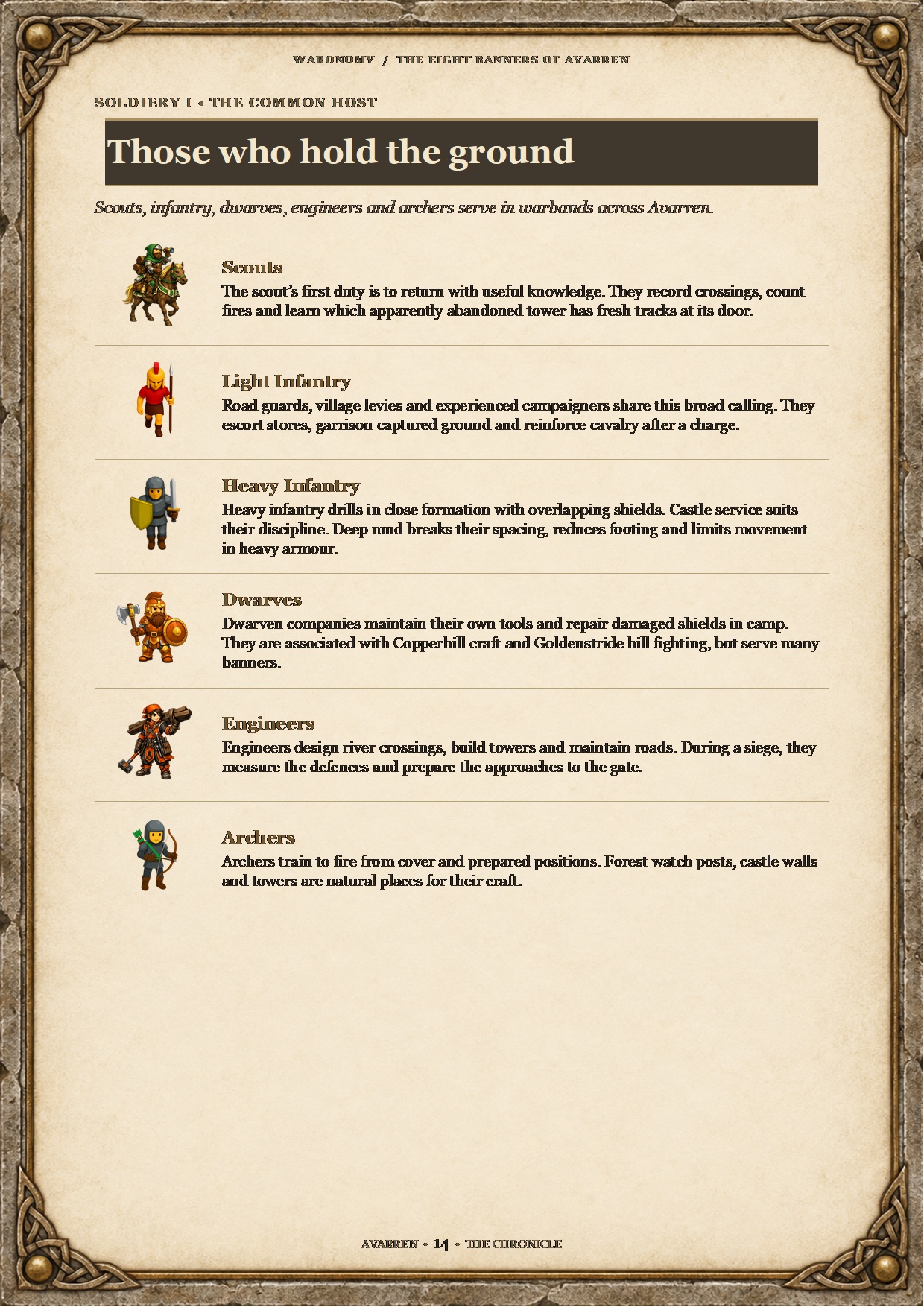
Scouts, infantry, dwarves, engineers and archers serve in warbands across Avarren.
The scout’s first duty is to return with useful knowledge. They record crossings, count fires and learn which apparently abandoned tower has fresh tracks at its door.
Road guards, village levies and experienced campaigners share this broad calling. They escort stores, garrison captured ground and reinforce cavalry after a charge.
Heavy infantry drills in close formation with overlapping shields. Castle service suits their discipline. Deep mud breaks their spacing, reduces footing and limits movement in heavy armour.
Dwarven companies maintain their own tools and repair damaged shields in camp. They are associated with Copperhill craft and Goldenstride hill fighting, but serve many banners.
Engineers design river crossings, build towers and maintain roads. During a siege, they measure the defences and prepare the approaches to the gate.
Archers train to fire from cover and prepared positions. Forest watch posts, castle walls and towers are natural places for their craft.
SOLDIERY II • THE MOVING HOST
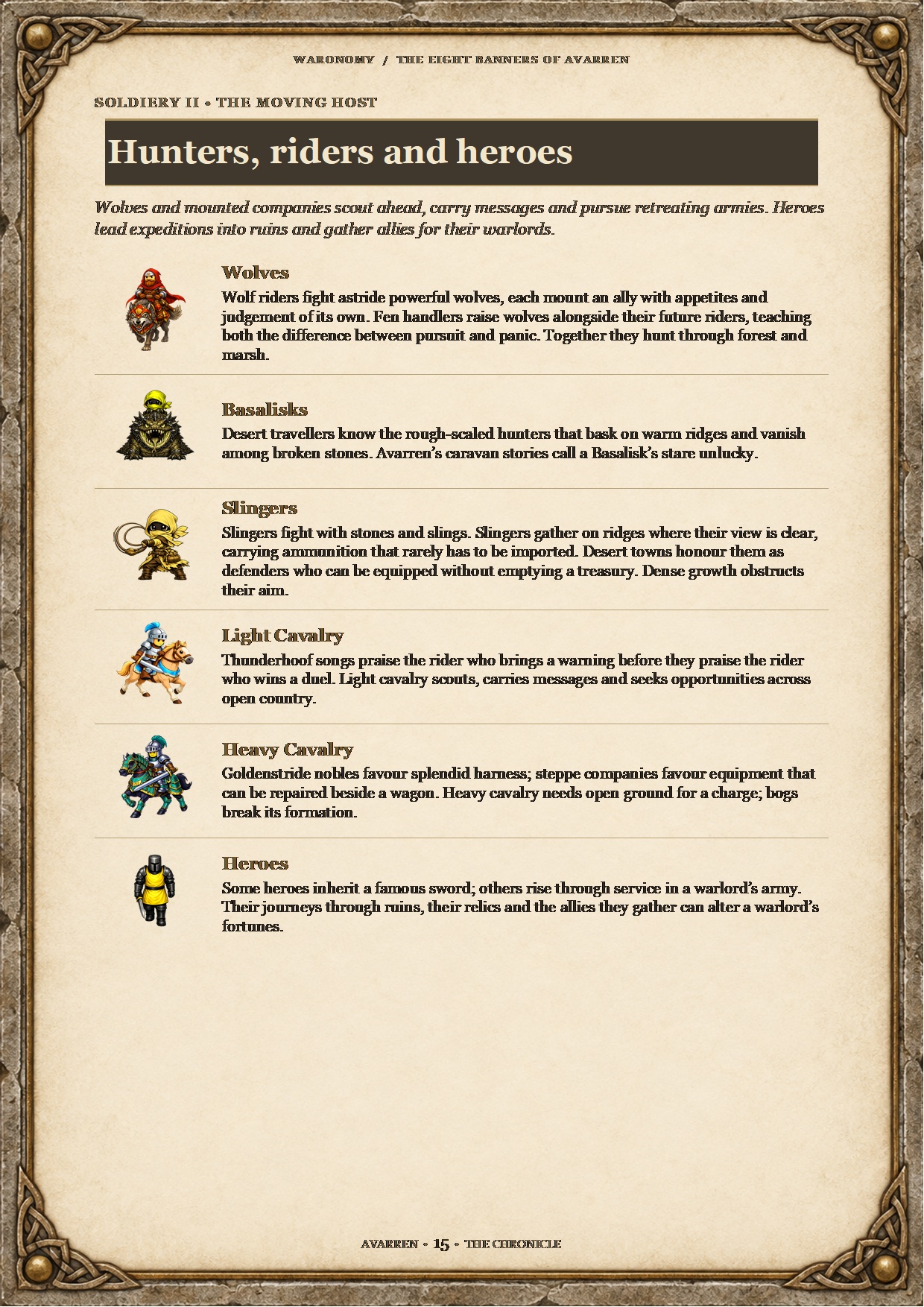
Wolves and mounted companies scout ahead, carry messages and pursue retreating armies. Heroes lead expeditions into ruins and gather allies for their warlords.
Wolf riders fight astride powerful wolves, each mount an ally with appetites and judgement of its own. Fen handlers raise wolves alongside their future riders, teaching both the difference between pursuit and panic. Together they hunt through forest and marsh.
Desert travellers know the rough-scaled hunters that bask on warm ridges and vanish among broken stones. Avarren’s caravan stories call a Basalisk’s stare unlucky.
Slingers fight with stones and slings. Slingers gather on ridges where their view is clear, carrying ammunition that rarely has to be imported. Desert towns honour them as defenders who can be equipped without emptying a treasury. Dense growth obstructs their aim.
Thunderhoof songs praise the rider who brings a warning before they praise the rider who wins a duel. Light cavalry scouts, carries messages and seeks opportunities across open country.
Goldenstride nobles favour splendid harness; steppe companies favour equipment that can be repaired beside a wagon. Heavy cavalry needs open ground for a charge; bogs break its formation.
Some heroes inherit a famous sword; others rise through service in a warlord’s army. Their journeys through ruins, their relics and the allies they gather can alter a warlord’s fortunes.
BESTIARY I • WINGS & WATER
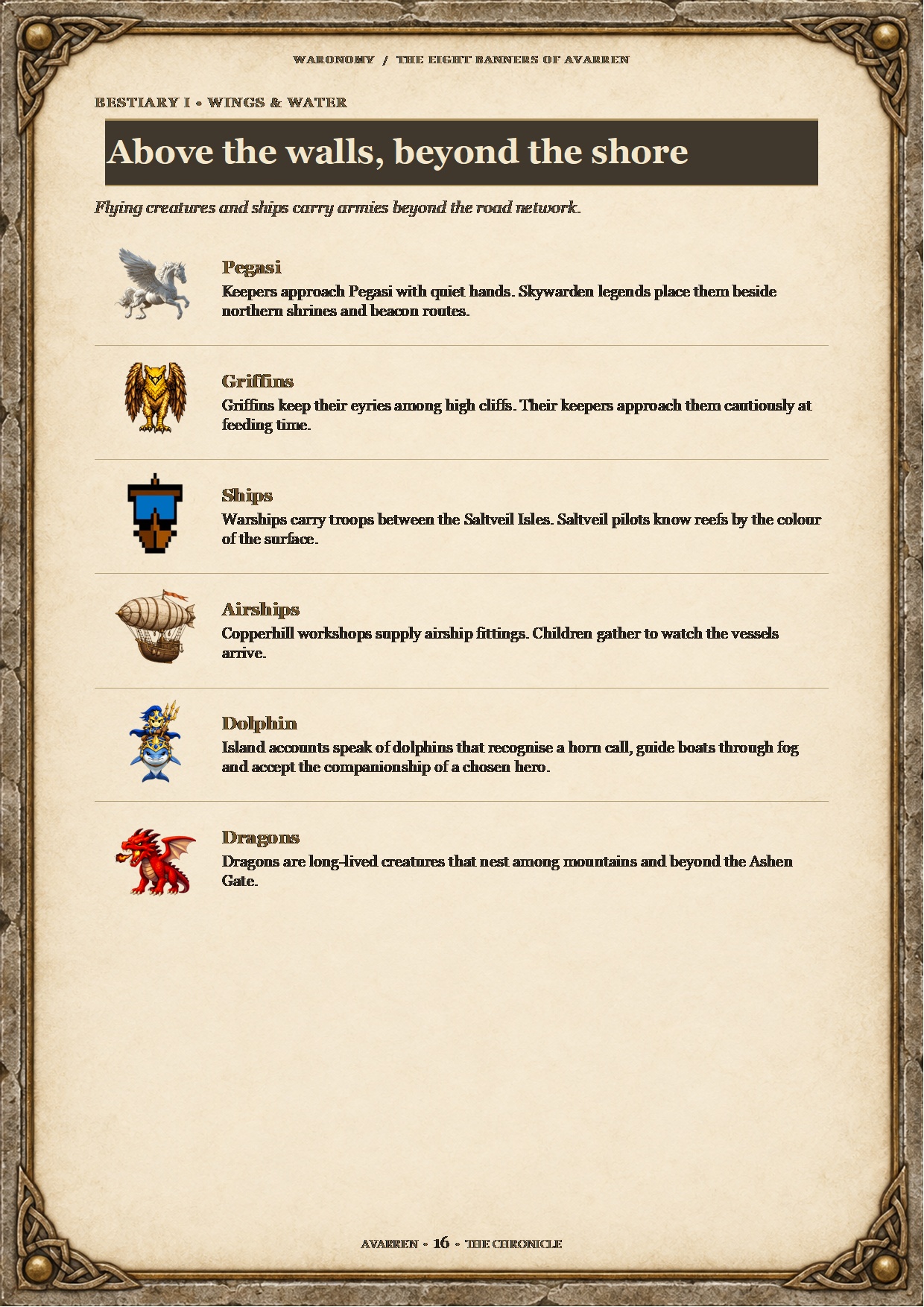
Flying creatures and ships carry armies beyond the road network.
Keepers approach Pegasi with quiet hands. Skywarden legends place them beside northern shrines and beacon routes.
Griffins keep their eyries among high cliffs. Their keepers approach them cautiously at feeding time.
Warships carry troops between the Saltveil Isles. Saltveil pilots know reefs by the colour of the surface.
Copperhill workshops supply airship fittings. Children gather to watch the vessels arrive.
Island accounts speak of dolphins that recognise a horn call, guide boats through fog and accept the companionship of a chosen hero.
Dragons are long-lived creatures that nest among mountains and beyond the Ashen Gate.
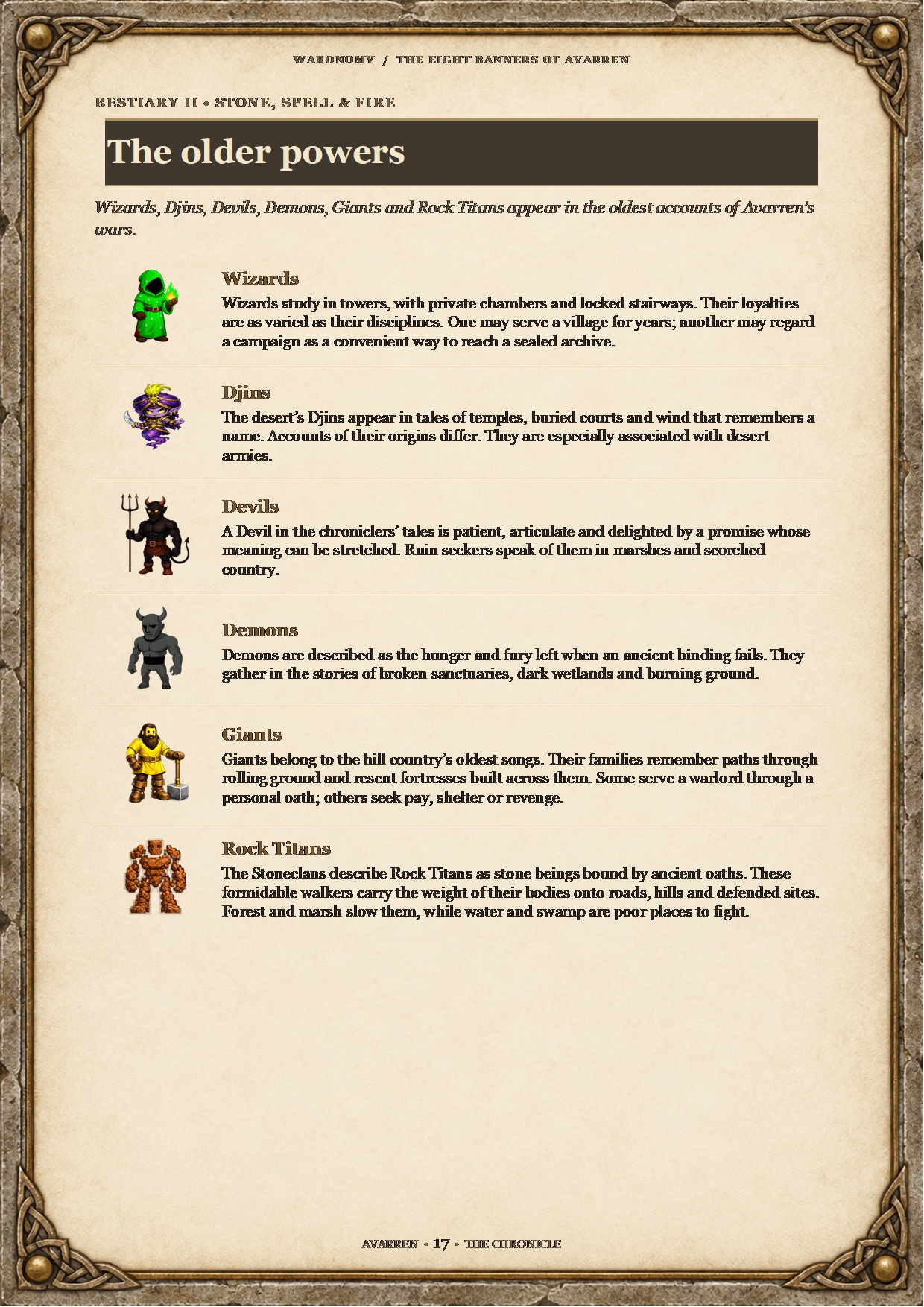
BESTIARY II • STONE, SPELL & FIRE
Wizards, Djins, Devils, Demons, Giants and Rock Titans appear in the oldest accounts of Avarren’s wars.
Wizards study in towers, with private chambers and locked stairways. Their loyalties are as varied as their disciplines. One may serve a village for years; another may regard a campaign as a convenient way to reach a sealed archive.
The desert’s Djins appear in tales of temples, buried courts and wind that remembers a name. Accounts of their origins differ. They are especially associated with desert armies.
A Devil in the chroniclers’ tales is patient, articulate and delighted by a promise whose meaning can be stretched. Ruin seekers speak of them in marshes and scorched country.
Demons are described as the hunger and fury left when an ancient binding fails. They gather in the stories of broken sanctuaries, dark wetlands and burning ground.
Giants belong to the hill country’s oldest songs. Their families remember paths through rolling ground and resent fortresses built across them. Some serve a warlord through a personal oath; others seek pay, shelter or revenge.
The Stoneclans describe Rock Titans as stone beings bound by ancient oaths. These formidable walkers carry the weight of their bodies onto roads, hills and defended sites. Forest and marsh slow them, while water and swamp are poor places to fight.
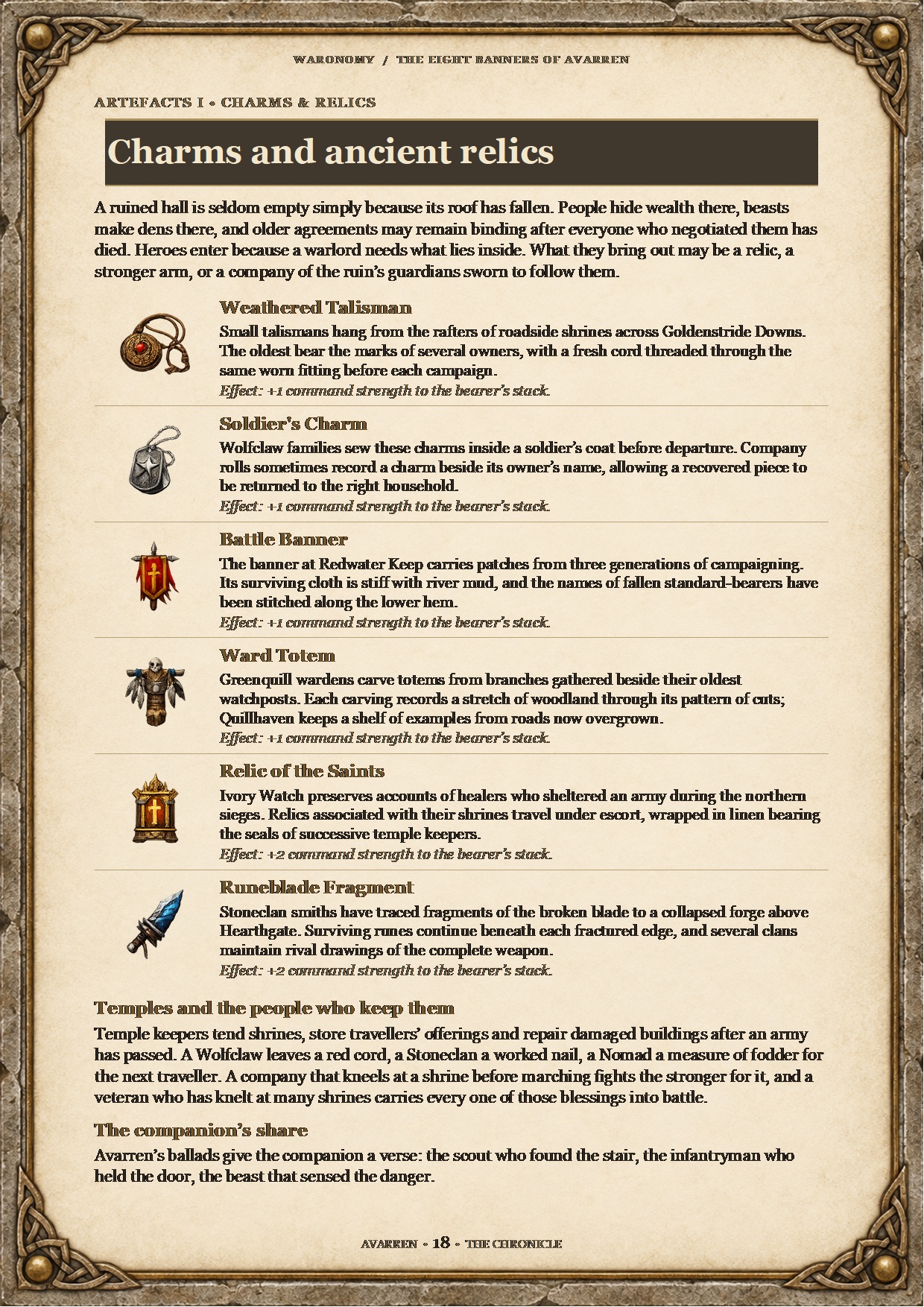
ARTEFACTS I • CHARMS & RELICS
A ruined hall is seldom empty simply because its roof has fallen. People hide wealth there, beasts make dens there, and older agreements may remain binding after everyone who negotiated them has died. Heroes enter because a warlord needs what lies inside. What they bring out may be a relic, a stronger arm, or a company of the ruin’s guardians sworn to follow them.
Small talismans hang from the rafters of roadside shrines across Goldenstride Downs. The oldest bear the marks of several owners, with a fresh cord threaded through the same worn fitting before each campaign.
Game effect: +1 command strength to the bearer’s stack.
Wolfclaw families sew these charms inside a soldier’s coat before departure. Company rolls sometimes record a charm beside its owner’s name, allowing a recovered piece to be returned to the right household.
Game effect: +1 command strength to the bearer’s stack.
The banner at Redwater Keep carries patches from three generations of campaigning. Its surviving cloth is stiff with river mud, and the names of fallen standard-bearers have been stitched along the lower hem.
Game effect: +1 command strength to the bearer’s stack.
Greenquill wardens carve totems from branches gathered beside their oldest watchposts. Each carving records a stretch of woodland through its pattern of cuts; Quillhaven keeps a shelf of examples from roads now overgrown.
Game effect: +1 command strength to the bearer’s stack.
Ivory Watch preserves accounts of healers who sheltered an army during the northern sieges. Relics associated with their shrines travel under escort, wrapped in linen bearing the seals of successive temple keepers.
Game effect: +2 command strength to the bearer’s stack.
Stoneclan smiths have traced fragments of the broken blade to a collapsed forge above Hearthgate. Surviving runes continue beneath each fractured edge, and several clans maintain rival drawings of the complete weapon.
Game effect: +2 command strength to the bearer’s stack.
Temple keepers tend shrines, store travellers’ offerings and repair damaged buildings after an army has passed. A Wolfclaw leaves a red cord, a Stoneclan a worked nail, a Nomad a measure of fodder for the next traveller. A company that kneels at a shrine before marching fights the stronger for it, and a veteran who has knelt at many shrines carries every one of those blessings into battle.
Avarren’s ballads give the companion a verse: the scout who found the stair, the infantryman who held the door, the beast that sensed the danger.
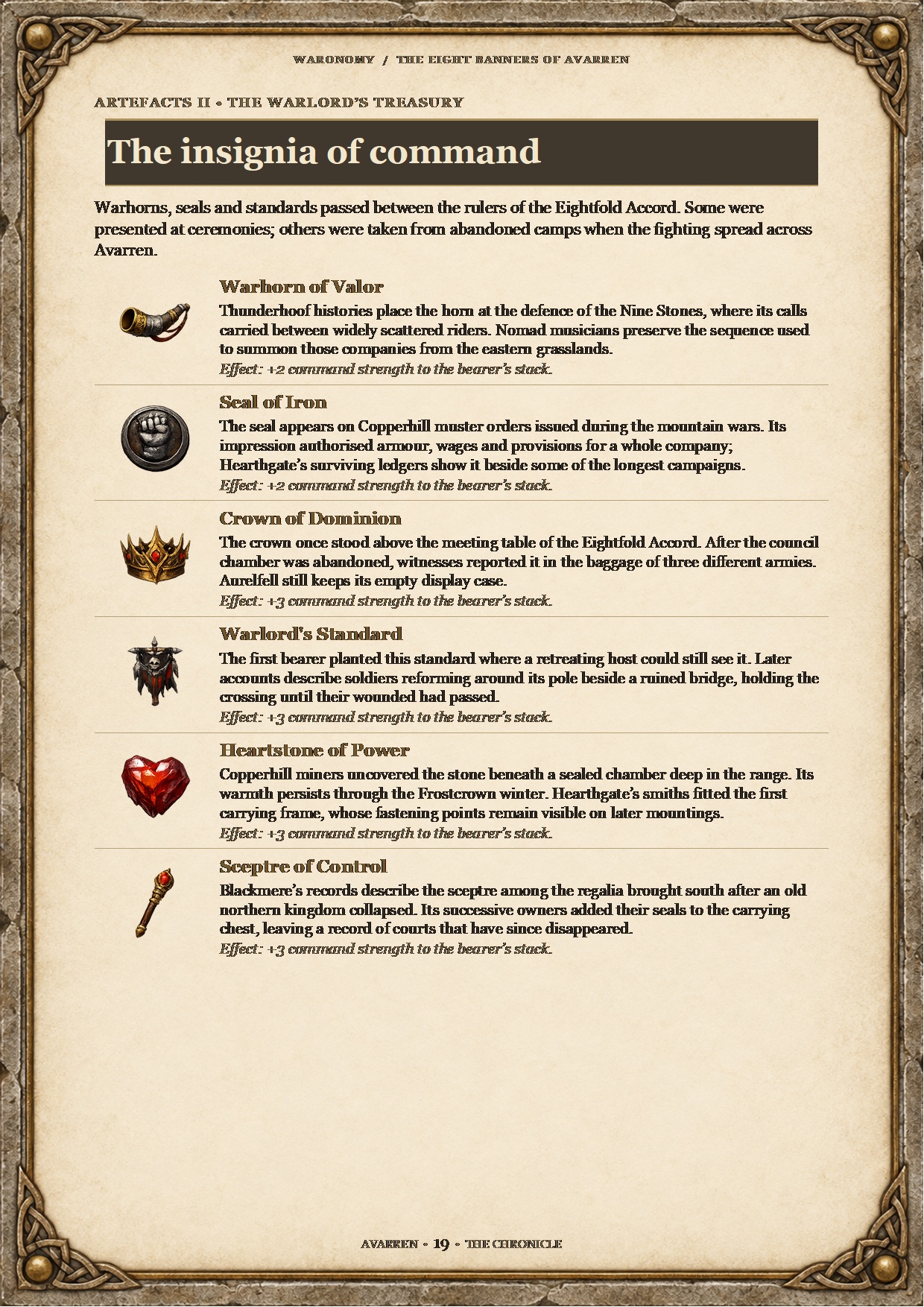
ARTEFACTS II • THE WARLORD’S TREASURY
Warhorns, seals and standards passed between the rulers of the Eightfold Accord. Some were presented at ceremonies; others were taken from abandoned camps when the fighting spread across Avarren.
Thunderhoof histories place the horn at the defence of the Nine Stones, where its calls carried between widely scattered riders. Nomad musicians preserve the sequence used to summon those companies from the eastern grasslands.
Game effect: +2 command strength to the bearer’s stack.
The seal appears on Copperhill muster orders issued during the mountain wars. Its impression authorised armour, wages and provisions for a whole company; Hearthgate’s surviving ledgers show it beside some of the longest campaigns.
Game effect: +2 command strength to the bearer’s stack.
The crown once stood above the meeting table of the Eightfold Accord. After the council chamber was abandoned, witnesses reported it in the baggage of three different armies. Aurelfell still keeps its empty display case.
Game effect: +3 command strength to the bearer’s stack.
The first bearer planted this standard where a retreating host could still see it. Later accounts describe soldiers reforming around its pole beside a ruined bridge, holding the crossing until their wounded had passed.
Game effect: +3 command strength to the bearer’s stack.
Copperhill miners uncovered the stone beneath a sealed chamber deep in the range. Its warmth persists through the Frostcrown winter. Hearthgate’s smiths fitted the first carrying frame, whose fastening points remain visible on later mountings.
Game effect: +3 command strength to the bearer’s stack.
Blackmere’s records describe the sceptre among the regalia brought south after an old northern kingdom collapsed. Its successive owners added their seals to the carrying chest, leaving a record of courts that have since disappeared.
Game effect: +3 command strength to the bearer’s stack.
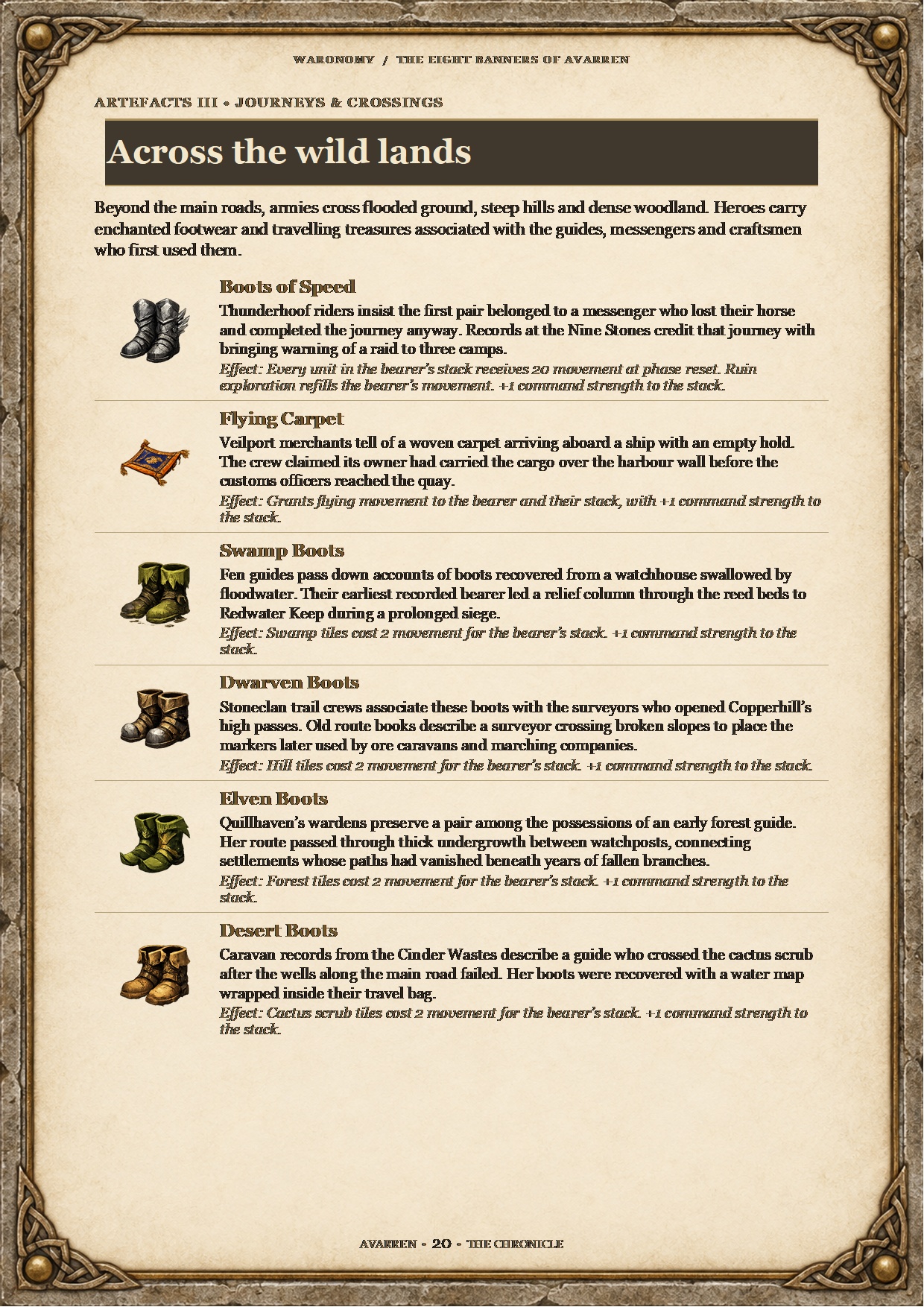
ARTEFACTS III • JOURNEYS & CROSSINGS
Beyond the main roads, armies cross flooded ground, steep hills and dense woodland. Heroes carry enchanted footwear and travelling treasures associated with the guides, messengers and craftsmen who first used them.
Thunderhoof riders insist the first pair belonged to a messenger who lost their horse and completed the journey anyway. Records at the Nine Stones credit that journey with bringing warning of a raid to three camps.
Game effect: Every unit in the bearer’s stack receives 20 movement at phase reset. Ruin exploration refills the bearer’s movement. +1 command strength to the stack.
Veilport merchants tell of a woven carpet arriving aboard a ship with an empty hold. The crew claimed its owner had carried the cargo over the harbour wall before the customs officers reached the quay.
Game effect: Grants flying movement to the bearer and their stack, with +1 command strength to the stack.
Fen guides pass down accounts of boots recovered from a watchhouse swallowed by floodwater. Their earliest recorded bearer led a relief column through the reed beds to Redwater Keep during a prolonged siege.
Game effect: Swamp tiles cost 2 movement for the bearer’s stack. +1 command strength to the stack.
Stoneclan trail crews associate these boots with the surveyors who opened Copperhill’s high passes. Old route books describe a surveyor crossing broken slopes to place the markers later used by ore caravans and marching companies.
Game effect: Hill tiles cost 2 movement for the bearer’s stack. +1 command strength to the stack.
Quillhaven’s wardens preserve a pair among the possessions of an early forest guide. Her route passed through thick undergrowth between watchposts, connecting settlements whose paths had vanished beneath years of fallen branches.
Game effect: Forest tiles cost 2 movement for the bearer’s stack. +1 command strength to the stack.
Caravan records from the Cinder Wastes describe a guide who crossed the cactus scrub after the wells along the main road failed. Her boots were recovered with a water map wrapped inside their travel bag.
Game effect: Cactus scrub tiles cost 2 movement for the bearer’s stack. +1 command strength to the stack.
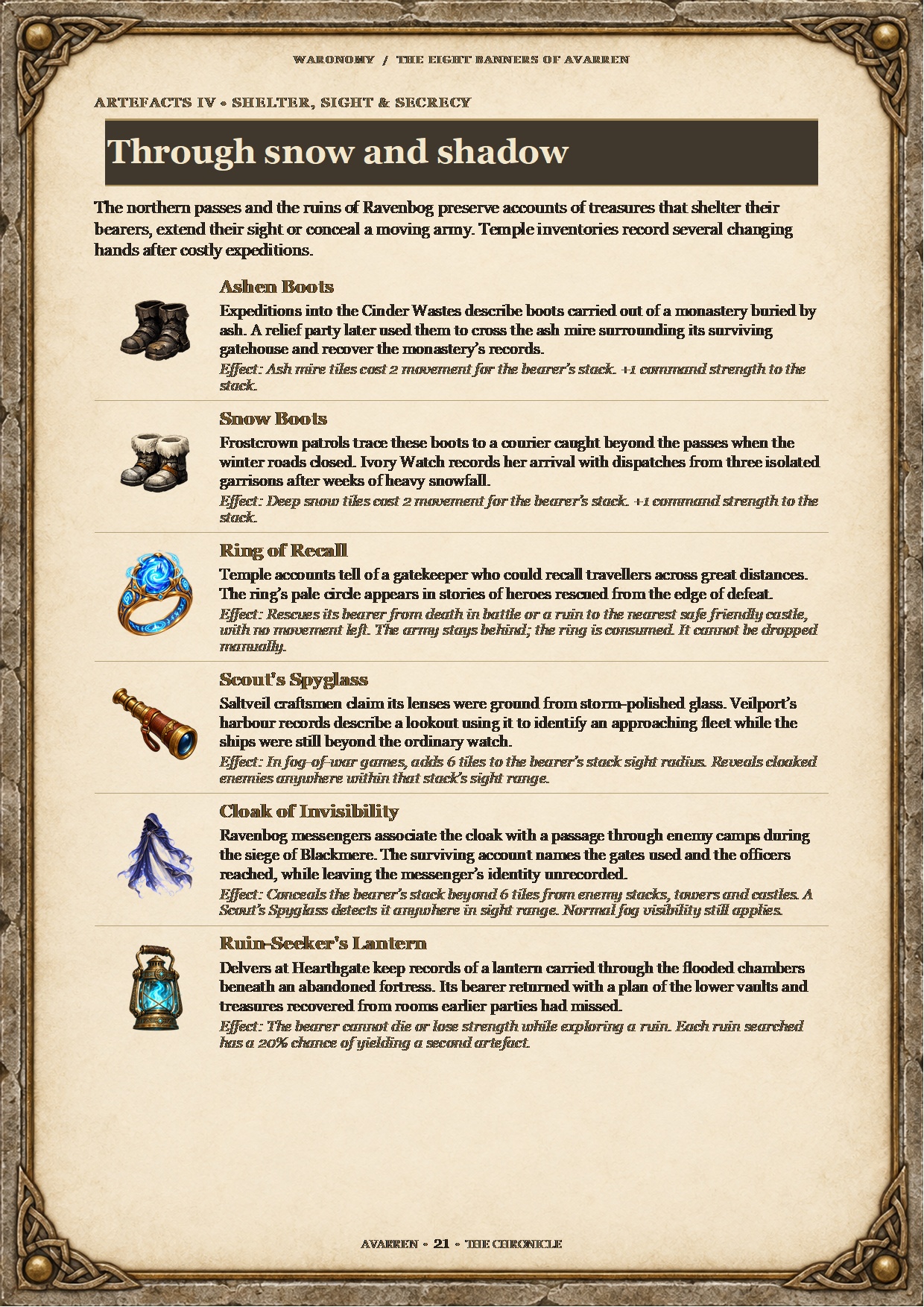
ARTEFACTS IV • SHELTER, SIGHT & SECRECY
The northern passes and the ruins of Ravenbog preserve accounts of treasures that shelter their bearers, extend their sight or conceal a moving army. Temple inventories record several changing hands after costly expeditions.
Expeditions into the Cinder Wastes describe boots carried out of a monastery buried by ash. A relief party later used them to cross the ash mire surrounding its surviving gatehouse and recover the monastery’s records.
Game effect: Ash mire tiles cost 2 movement for the bearer’s stack. +1 command strength to the stack.
Frostcrown patrols trace these boots to a courier caught beyond the passes when the winter roads closed. Ivory Watch records her arrival with dispatches from three isolated garrisons after weeks of heavy snowfall.
Game effect: Deep snow tiles cost 2 movement for the bearer’s stack. +1 command strength to the stack.
Temple accounts tell of a gatekeeper who could recall travellers across great distances. The ring’s pale circle appears in stories of heroes rescued from the edge of defeat.
Game effect: Rescues its bearer from death in battle or a ruin to the nearest safe friendly castle, with no movement left. The army stays behind; the ring is consumed. It cannot be dropped manually.
Saltveil craftsmen claim its lenses were ground from storm-polished glass. Veilport’s harbour records describe a lookout using it to identify an approaching fleet while the ships were still beyond the ordinary watch.
Game effect: In fog-of-war games, adds 6 tiles to the bearer’s stack sight radius. Reveals cloaked enemies anywhere within that stack’s sight range.
Ravenbog messengers associate the cloak with a passage through enemy camps during the siege of Blackmere. The surviving account names the gates used and the officers reached, while leaving the messenger’s identity unrecorded.
Game effect: Conceals the bearer’s stack beyond 6 tiles from enemy stacks, towers and castles. A Scout’s Spyglass detects it anywhere in sight range. Normal fog visibility still applies.
Delvers at Hearthgate keep records of a lantern carried through the flooded chambers beneath an abandoned fortress. Its bearer returned with a plan of the lower vaults and treasures recovered from rooms earlier parties had missed.
Game effect: The bearer cannot die or lose strength while exploring a ruin. Each ruin searched has a 20% chance of yielding a second artefact.
BORDER TALES & CAMPAIGN SEEDS
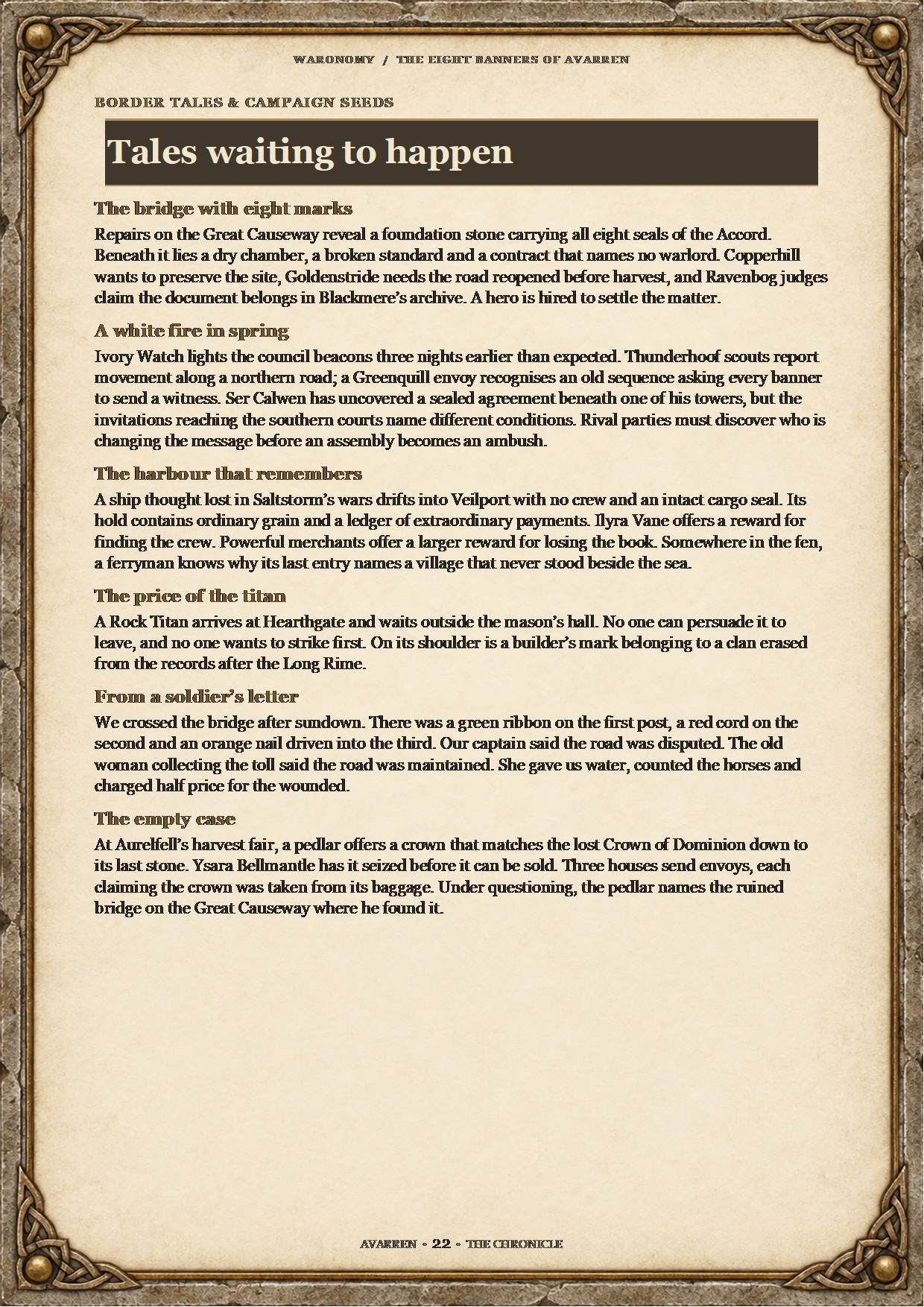
Repairs on the Great Causeway reveal a foundation stone carrying all eight seals of the Accord. Beneath it lies a dry chamber, a broken standard and a contract that names no warlord. Copperhill wants to preserve the site, Goldenstride needs the road reopened before harvest, and Ravenbog judges claim the document belongs in Blackmere’s archive. A hero is hired to settle the matter.
Ivory Watch lights the council beacons three nights earlier than expected. Thunderhoof scouts report movement along a northern road; a Greenquill envoy recognises an old sequence asking every banner to send a witness. Ser Calwen has uncovered a sealed agreement beneath one of his towers, but the invitations reaching the southern courts name different conditions. Rival parties must discover who is changing the message before an assembly becomes an ambush.
A ship thought lost in Saltstorm’s wars drifts into Veilport with no crew and an intact cargo seal. Its hold contains ordinary grain and a ledger of extraordinary payments. Ilyra Vane offers a reward for finding the crew. Powerful merchants offer a larger reward for losing the book. Somewhere in the fen, a ferryman knows why its last entry names a village that never stood beside the sea.
A Rock Titan arrives at Hearthgate and waits outside the mason’s hall. No one can persuade it to leave, and no one wants to strike first. On its shoulder is a builder’s mark belonging to a clan erased from the records after the Long Rime.
We crossed the bridge after sundown. There was a green ribbon on the first post, a red cord on the second and an orange nail driven into the third. Our captain said the road was disputed. The old woman collecting the toll said the road was maintained. She gave us water, counted the horses and charged half price for the wounded.
At Aurelfell’s harvest fair, a pedlar offers a crown that matches the lost Crown of Dominion down to its last stone. Ysara Bellmantle has it seized before it can be sold. Three houses send envoys, each claiming the crown was taken from its baggage. Under questioning, the pedlar names the ruined bridge on the Great Causeway where he found it.
NAMES, GROUND & THE LIMITS OF THE CHRONICLE
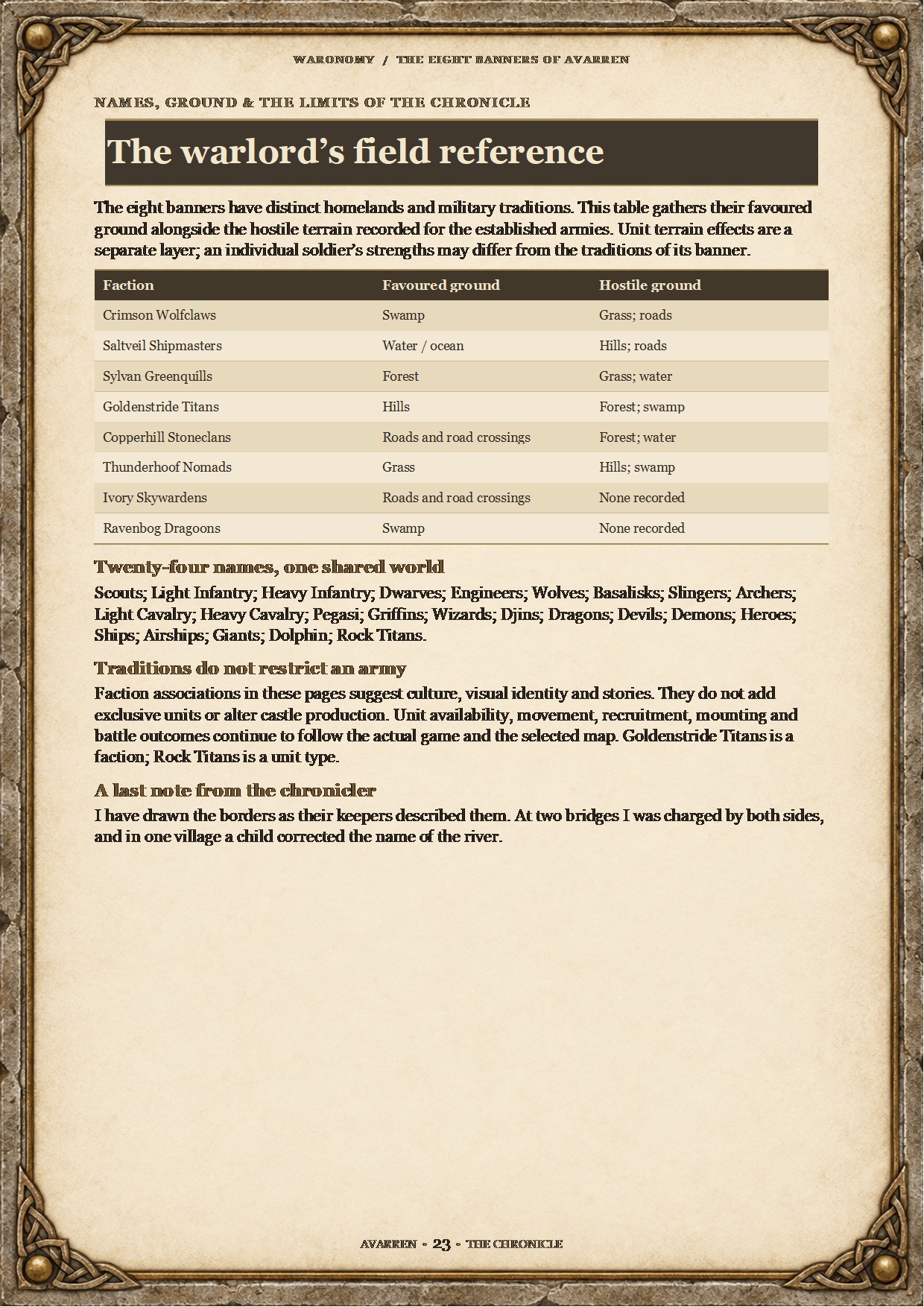
The eight banners have distinct homelands and military traditions. This table gathers their favoured ground alongside the hostile terrain recorded for the established armies. Unit terrain effects are a separate layer; an individual soldier’s strengths may differ from the traditions of its banner.
| Faction | Favoured ground | Hostile ground |
|---|---|---|
| Crimson Wolfclaws | Swamp | Grass; roads |
| Saltveil Shipmasters | Water / ocean | Hills; roads |
| Sylvan Greenquills | Forest | Grass; water |
| Goldenstride Titans | Hills | Forest; swamp |
| Copperhill Stoneclans | Roads and road crossings | Forest; water |
| Thunderhoof Nomads | Grass | Hills; swamp |
| Ivory Skywardens | Roads and road crossings | None recorded |
| Ravenbog Dragoons | Swamp | None recorded |
Scouts; Light Infantry; Heavy Infantry; Dwarves; Engineers; Wolves; Basalisks; Slingers; Archers; Light Cavalry; Heavy Cavalry; Pegasi; Griffins; Wizards; Djins; Dragons; Devils; Demons; Heroes; Ships; Airships; Giants; Dolphin; Rock Titans.
Faction associations in these pages suggest culture, visual identity and stories. They do not add exclusive units or alter castle production. Unit availability, movement, recruitment, mounting and battle outcomes continue to follow the actual game and the selected map. Goldenstride Titans is a faction; Rock Titans is a unit type.
I have drawn the borders as their keepers described them. At two bridges I was charged by both sides, and in one village a child corrected the name of the river.